Short answer: for most garages in the GTA and Southern Ontario, a polyaspartic flake system is the better choice. Epoxy still has a place, mostly indoors. Here’s why.
What they are
Epoxy is a two-part resin that cures into a hard, thick film. It bonds very well to properly ground concrete, builds thickness quickly and comes in solid colours, flake and metallic finishes.
Polyaspartic is a type of polyurea. It also bonds to ground concrete, but it cures much faster, stays flexible enough to handle temperature swings, and doesn’t yellow in sunlight.
How they compare in a Canadian garage
| Epoxy | Polyaspartic | |
|---|---|---|
| Sunlight (UV) | Ambers and yellows over time near open doors | UV-stable, stays clear |
| Cure time | Usually several days before parking | Often one-day install, cars back in a day or two |
| Road salt and chemicals | Good | Very good |
| Hot tire pickup | Can lift if the system is thin or poorly prepped | Very resistant when installed over a ground slab |
| Cold-weather install | Slow to cure in a cold garage | Cures at lower temperatures |
| Build thickness | Builds thick in one coat | Thinner coats, built in layers |
| Working time | Longer, good for metallic designs | Short, needs an experienced crew |
Why most garages get polyaspartic
A garage in Ontario takes a beating that a basement never sees: salt slush melting off the car all winter, hot tires in summer, and sunlight through the open door. Polyaspartic handles all three. It also lets us finish most garages in one day, which matters when the garage is where you park.
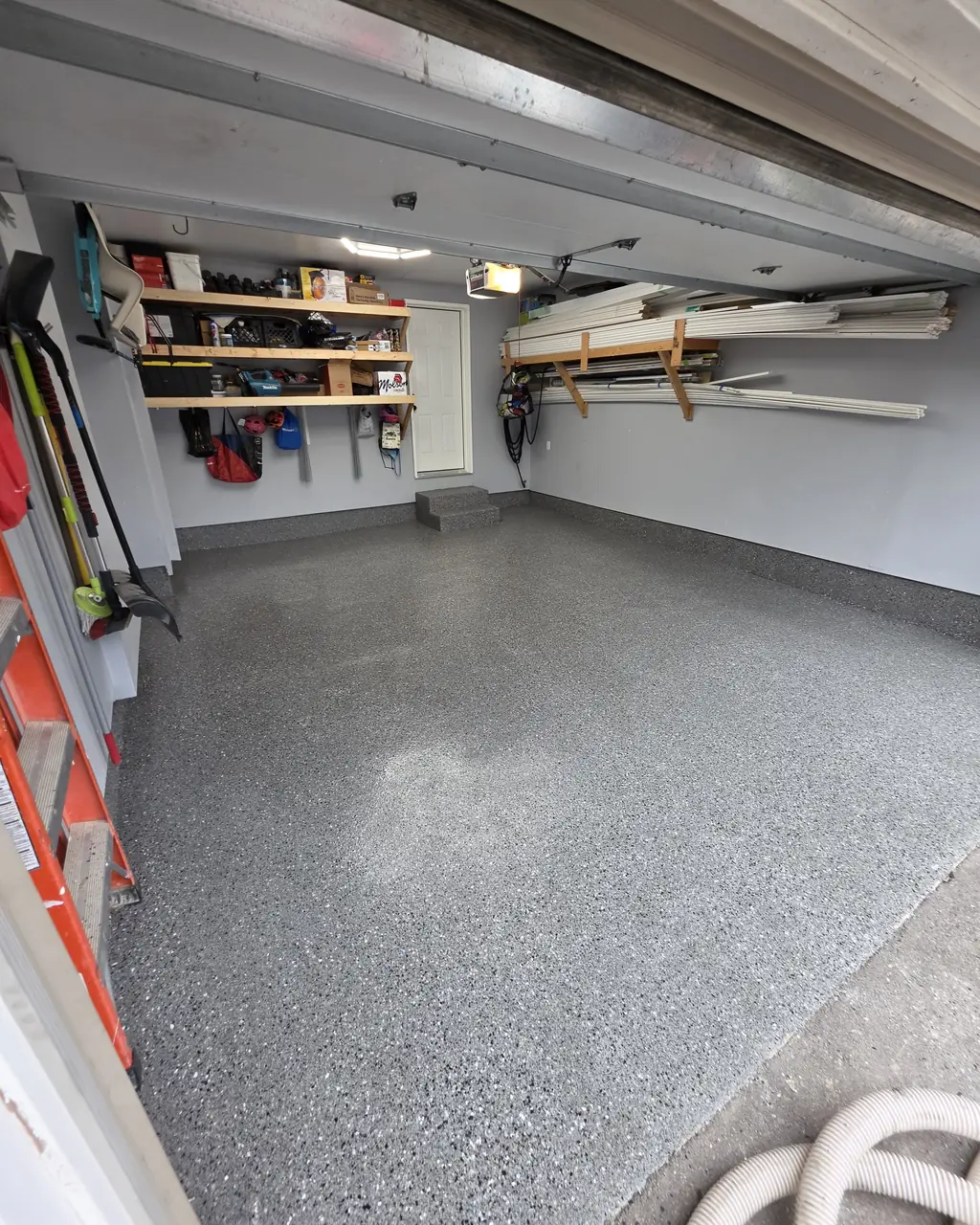
Our garage system is a full-broadcast flake floor with a polyaspartic base and a clear polyaspartic topcoat, over a diamond-ground slab. On garages with moisture or older concrete, we start with a moisture vapour barrier and make it a two-day install. You can see the full build-up on our garage floor page.
Where epoxy still wins
Epoxy is still the right resin for a lot of floors, just usually not as the top layer of a sunny garage:
- Basements, where there’s no sun and build thickness matters. Our basement system is a moisture vapour barrier, epoxy and a polyurethane topcoat.
- Metallic floors, because epoxy’s longer working time is what lets us move the pigment. See our metallic epoxy floors.
- Industrial floors, where high-build, quartz and novolac epoxies take forklifts and chemicals.
The part that matters more than the resin
Most failed garage floors you see online, the ones peeling in sheets, aren’t failures of epoxy or polyaspartic. They’re failures of prep: a coating rolled onto acid-etched or unprepared concrete. Whatever system you choose, ask how the concrete will be prepared. We diamond-grind every slab, repair cracks and joints, and test for moisture before anything is applied.
Watch out for “one-coat” kits
Store-bought kits are usually thin water-based epoxy with no grinding. They can look good for a season, then lift under hot tires. A professional system is several times thicker and bonded into ground concrete.
Want a straight answer for your floor?
We’ll look at the slab, test it, and tell you which system makes sense, in writing.