
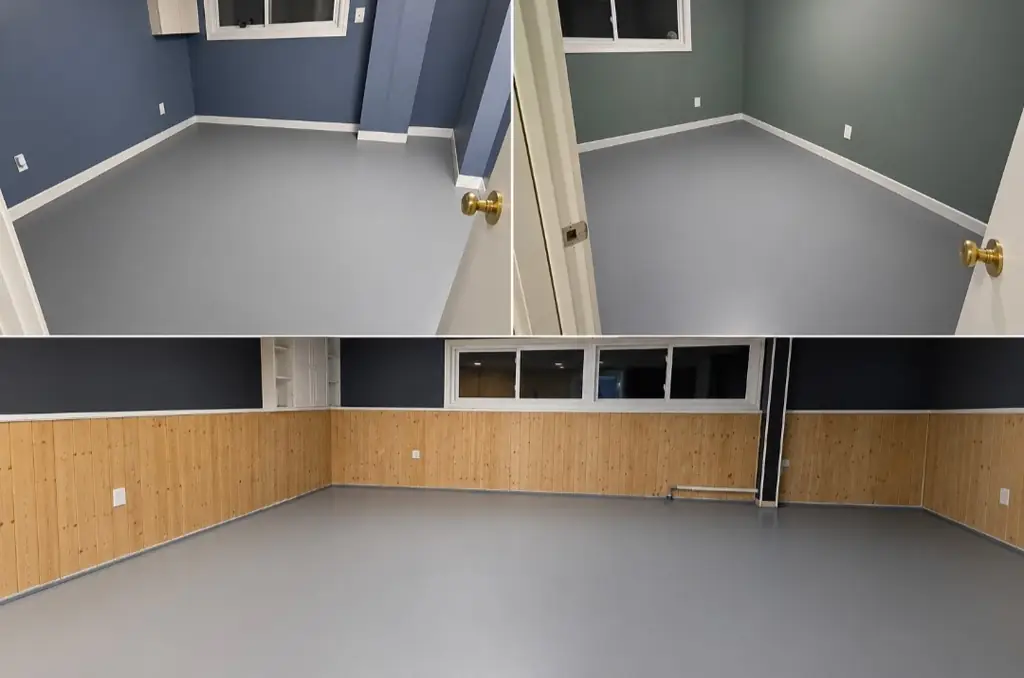
When a basement floor coating fails, moisture is the usual cause. The fix isn’t a better topcoat. It’s testing the slab and putting the right barrier down first.
Why basement slabs carry moisture
A basement slab sits directly on the ground. Even when the floor feels dry, water vapour moves up through the concrete and out of the surface. Older homes often have no vapour barrier under the slab at all, and newer homes can still have high readings in the first years after the concrete is poured.
Bare concrete lets that vapour escape. A coating traps it at the bond line. Over time, the pressure can push the coating off the slab.
Signs a slab has a moisture problem
- White, powdery deposits on the concrete (efflorescence)
- Dark, damp patches that come and go
- Old paint or coatings bubbling, flaking or peeling
- Musty smells or mould on carpet backing or underlay
- Tile or flooring adhesive that has gone soft
How concrete moisture is tested
There are three common tests. They answer slightly different questions:
- Plastic sheet test (ASTM D4263). A square of plastic is taped to the floor. If condensation forms underneath or the concrete darkens, moisture is coming through. It’s a quick yes or no, not a measurement.
- Calcium chloride test (ASTM F1869). Measures how much moisture is coming out of the surface over a set time.
- In-situ relative humidity (ASTM F2170). A probe placed in a drilled hole measures humidity inside the slab. Many coating and flooring manufacturers base their limits on this test.
We moisture-test every basement slab before quoting a system. On top of the readings, we look at the history of the space: past flooding, sump pumps, and what’s happened to previous flooring.
What a moisture vapour barrier does
A moisture vapour barrier, or MVB, is a specialised epoxy primer designed to bond to damp concrete and hold back vapour pressure from below. It goes down first, straight onto the diamond-ground slab. The rest of the system bonds to it instead of to the wet concrete.
Our basement system is built in three layers: MVB, epoxy body coat, then a polyurethane topcoat for wear and easy cleaning. You can see each layer on our basement floor page.
What a coating can’t fix
An MVB handles vapour coming through the concrete. It’s not a fix for liquid water: active leaks, cracks that let water in, or a basement that floods. Those need to be dealt with first, through grading, drainage, waterproofing or a sump. If we see signs of that at the site visit, we’ll tell you.
Prep still matters most
Even the best barrier needs an open, clean concrete surface to bond to. We diamond-grind to remove tile adhesive, paint and the weak top layer, repair cracks, then apply the MVB. That’s what keeps a basement floor bonded for years.
Want a straight answer for your floor?
We’ll look at the slab, test it, and tell you which system makes sense, in writing.