Industrial floor coatings for forklifts, chemicals & shift work
Quartz, novolac and high-build epoxy systems for warehouses, production floors, fabrication shops and service bays across the GTA, phased around your operation.
Where our industrial systems go
Bare concrete dusts, stains and breaks down under traffic. A bonded resin system protects the slab, brightens the space and makes cleanup fast.
Warehouses and distribution
Forklift aisles, racking areas and pallet traffic. Seals out dust that gets into product and equipment.
Manufacturing and production
Impact, abrasion and spills from the production line, with a topcoat matched to what you run.
Fabrication and machine shops
Dropped parts, cutting fluids and grinding debris. Built thick to take it.
Auto service and mechanic bays
Oil, coolant, brake fluid and hot tires. Easy to squeegee and degrease.
Loading areas
Textured quartz for grip where snow and water track in from the dock.
Mechanical and equipment rooms
Sealed, light-coloured floors that make leaks easy to spot.
A double-broadcast quartz system, layer by layer
This is our go-to build for warehouses, production floors and service bays: thick, textured and made to take heavy traffic and spills. Tap a step to see the layer.
Industrial systems
We match the system to your traffic, your chemicals and your downtime window, and put the reasons in the quote.
Double-broadcast quartz
Two body coats with quartz aggregate broadcast to refusal, sealed with a grout coat and topcoat. Thick, textured and impact-resistant.
Best forWarehouses, production floors, loading areas, wet areas
Novolac epoxy
A chemical-resistant epoxy for floors exposed to acids, solvents, fuels and aggressive cleaners. Used as a topcoat or a full system.
Best forBattery rooms, chemical storage, process areas, service bays
High-build epoxy
Two coats of solid-colour industrial epoxy, often over a moisture vapour barrier, finished with a polyurethane topcoat for abrasion and chemical resistance. Optional anti-slip and safety colours.
Best forFabrication, assembly, storage, mechanical rooms
Urethane cement (self-levelling)
A cement and polyurethane hybrid poured as a self-levelling floor. Seamless, thermal-shock resistant and built for hot washdowns, food acids and constant moisture.
Best forFood and beverage processing, breweries, commercial kitchens, cold storage, washdown areas
Polyaspartic topcoats
Fast-cure, UV-stable wear layers that get the floor back in service sooner and stay clear near open doors.
Best forShort shutdown windows, sun-exposed bays
Urethane cement for wet, hot and cold floors
Urethane cement, also called polyurethane concrete, is a blend of cement and polyurethane resin. ArNy has installed it as a self-levelling system: it’s poured thicker than a coating and flows out flat, so it can even out a worn slab while leaving a seamless, hard-wearing surface.
It’s the system we reach for when epoxy alone won’t survive the conditions: daily hot-water washdowns, steam cleaning, spills of food acids and fats, or a slab that swings between freezer and oven temperatures.
- Self-levelling pour that smooths out an uneven or worn slab
- Handles hot-water washdowns and steam cleaning
- Resists thermal shock from freezers, coolers and ovens
- Stands up to food acids, fats, sugars and many cleaning chemicals
- More tolerant of damp concrete than standard epoxy
- Smooth finish, or textured for slip resistance in wet areas
Best for: commercial kitchens, food and beverage processing, breweries, bakeries, cold storage, walk-in coolers and freezers, and washdown areas.
Ask about urethane cementPrep that holds under load
Industrial coatings fail at the bond line. Most of our time on an industrial job goes into the concrete before any coating goes down.
- Degreasing and contamination testing on oil-soaked slabs
- Husqvarna planetary diamond grinding to a proper concrete surface profile
- HEPA dust extraction at the grinder, so dust stays out of your product and equipment
- Crack, spall and joint repair before coating
- Moisture testing on slabs on grade
- Walkways and safety zones laid out in contrasting colours
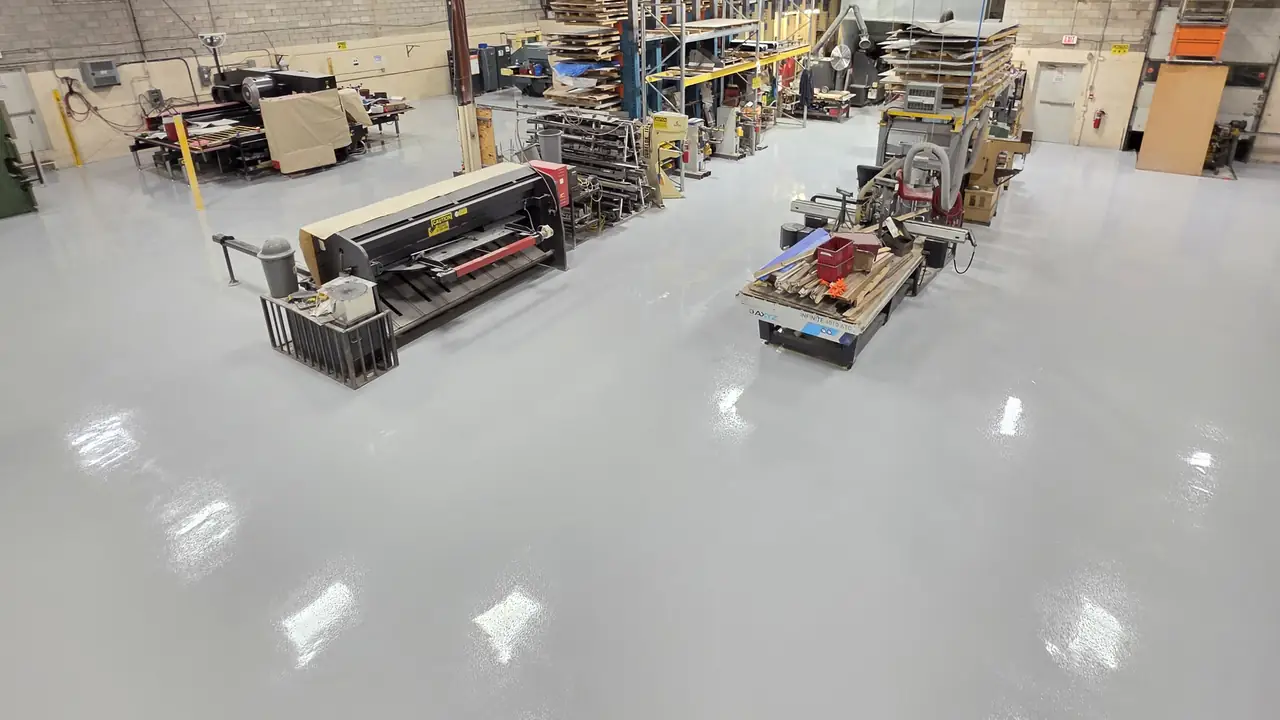
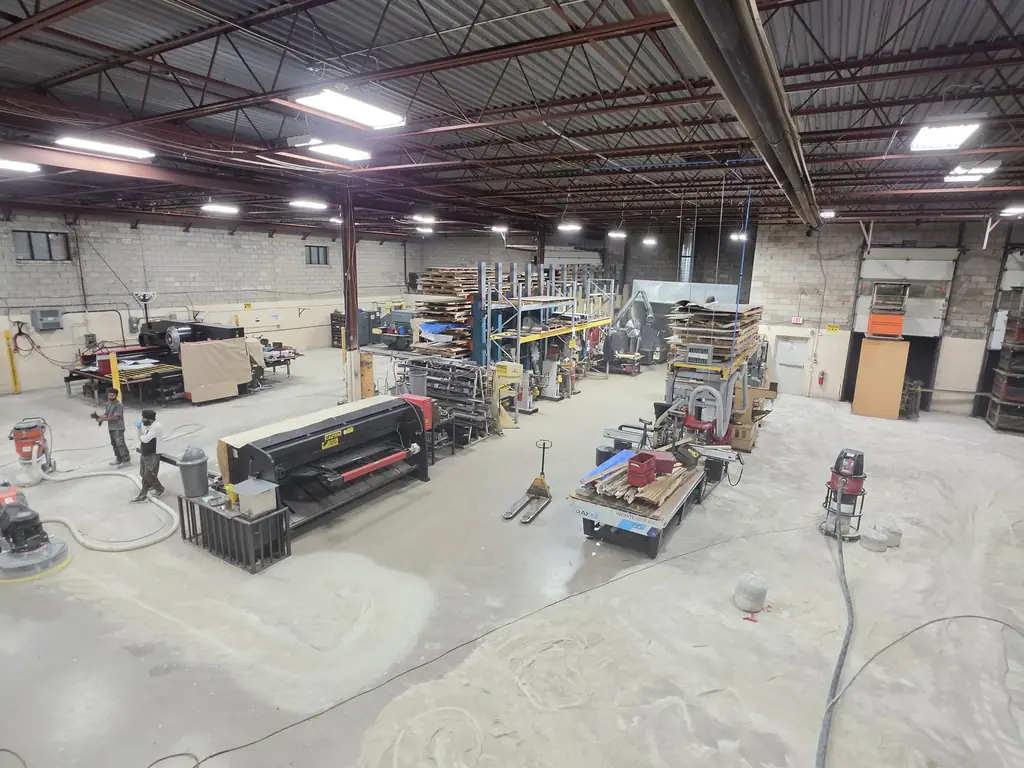
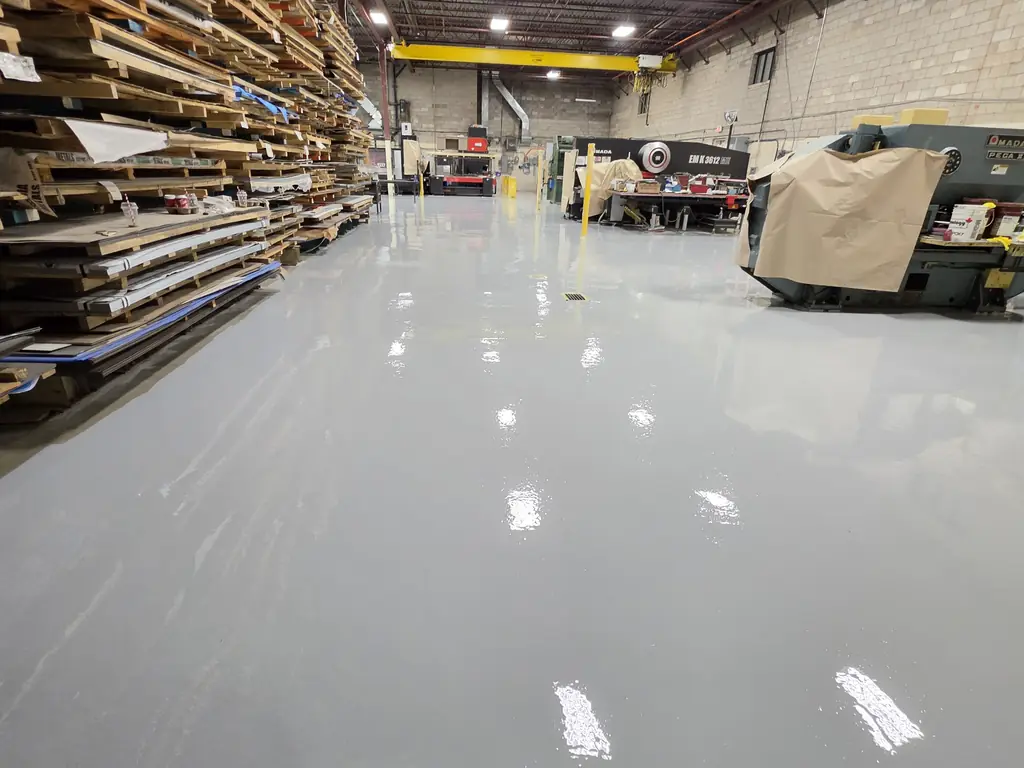
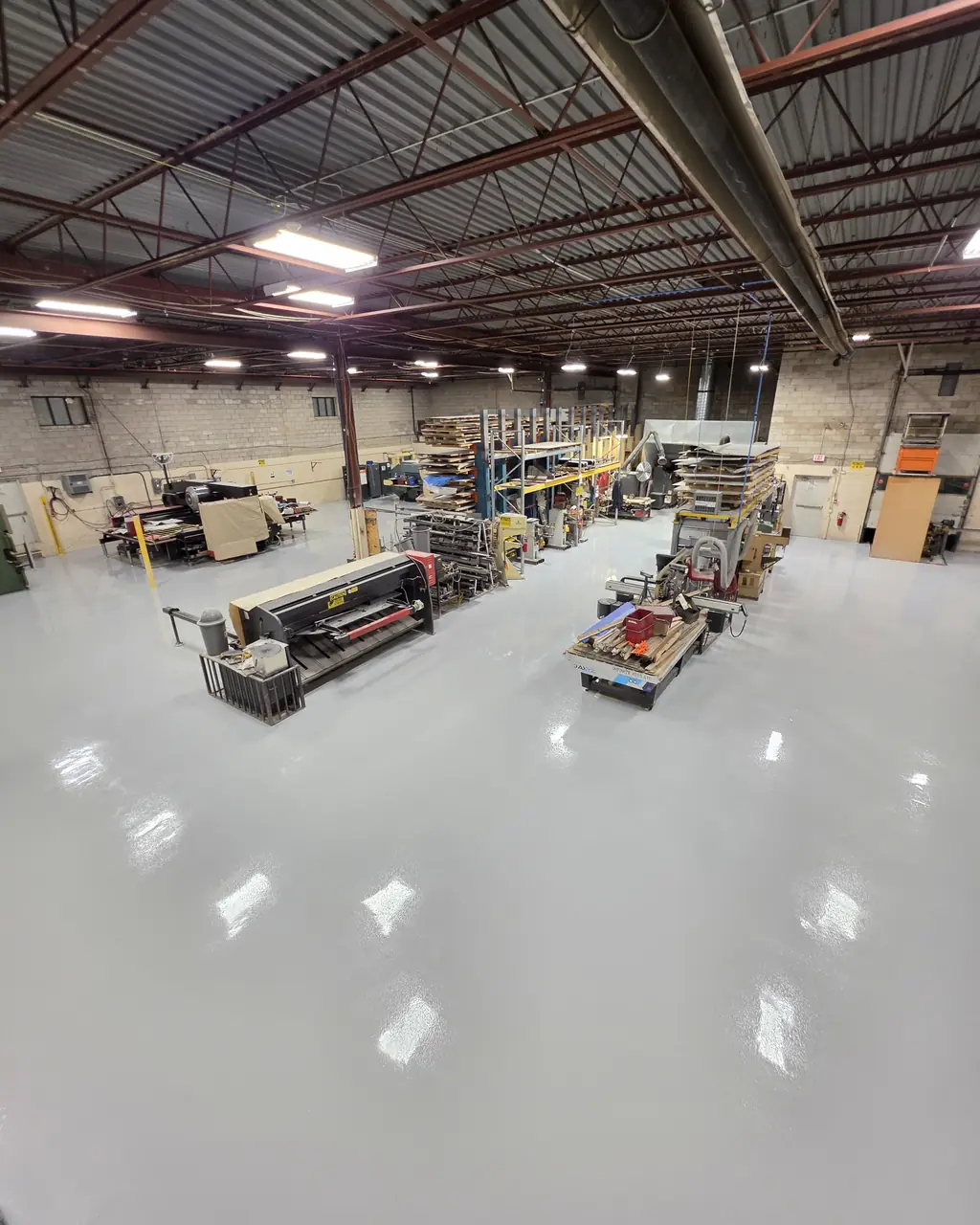
A fabrication shop, before and after
Sheet-metal shop in Mississauga. Machinery stayed in place; the floor was ground with HEPA extraction, repaired, sealed with a moisture vapour barrier, then finished with two coats of industrial grey epoxy and a polyurethane topcoat.
Planned around your downtime
Walkthrough
We walk the floor with your facility or operations lead, test the slab and note traffic, chemicals and problem areas.
Scope and schedule
A written scope with the system, zones, sequence, cure times and price, built around your shifts or shutdown.
Phased install
We prep and coat zone by zone, nights or weekends if needed, and hand each area back as it cures.
Handover
Final walkthrough, care and cleaning guidance, and documentation for your maintenance file.
Need a floor priced for a tender or budget?
Send drawings, square footage and what the floor is exposed to. We’ll come back with a written system recommendation and price.
Industrial floor questions
What is urethane cement, and when do you use it?
Urethane cement is a cement and polyurethane hybrid that we install as a self-levelling floor. We spec it for spaces that are wet, hot, cold or see food acids and harsh cleaners, such as commercial kitchens, food and beverage plants, breweries and cold storage, where a standard epoxy would struggle.
How long will the area be out of service?
It depends on the system and the size. Epoxy and quartz systems usually need a few days before forklift traffic; fast-cure topcoats shorten that. We can phase the work zone by zone and schedule around shifts and shutdowns.
Can you coat the floor in sections while we keep running?
Yes. We split the floor into zones, coat one while the rest of the plant runs, then move. Dust is captured at the grinder with HEPA extraction.
Which system handles chemicals?
Novolac epoxy is our choice where acids, solvents, fuels or harsh cleaners are present. Tell us what’s spilled on your floor and we’ll match the topcoat to it.
Will it take forklift traffic?
Yes. Double-broadcast quartz and high-build epoxy systems are made for forklifts, pallet jacks and carts. Very heavy point loads and steel wheels are something we look at on site.
Our concrete is oil-soaked. Can it be coated?
Usually. We degrease, grind and test. Heavily contaminated areas may need extra cleaning or cutting out and patching first. We’ll tell you on the site visit what it takes.
Can you add walkways and safety zones?
Yes. Walkways, work cells and hazard zones can be laid out in contrasting coating colours as part of the system.
Get an industrial floor quote
Tell us about the facility, the traffic and what gets spilled. We’ll walk the floor, test the slab and send a written scope and schedule.
- Call or text647-971-2769
Monday to Saturday, 7am to 7pm - Emailinfo@arnycoatings.com
We reply within 24 hours - Based in MississaugaServing the Greater Toronto Area